Showing posts with label Books From The Bin. Show all posts

Sunday, October 9, 2022

Books from the Bin: Mindscan

If you've read anything I've written, you probably know that I like to think about the confines of identity, how it changes, what constitutes it, and all that. So maybe you can understand my mindset when I saw a certain book in the fabled bin, and why I had to read the whole goddamn thing. So here we are.

Books From the Bin: Mindscan by Robert J. Sawyer
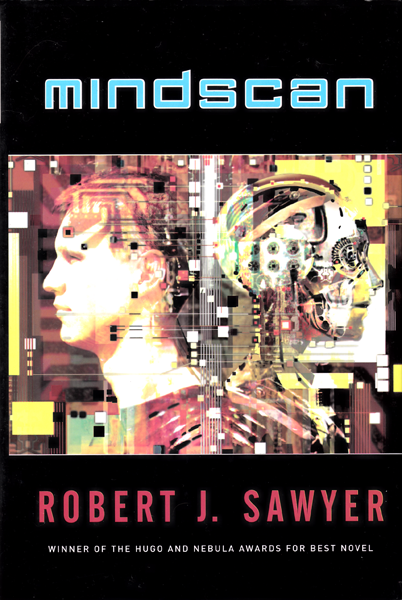

Now that we're looking at the same cover, I hope you can see what I saw. To my mind this was probably a Dickian or Asimovian sci-fi book, with the questions of what constitutes artificial life, what makes a person a person, and what happens when there are two of you?

I don't think I would be writing this if it was that. Lemme lay out the plot for you. In the far off future year of 2045, the corporation Immortex has created a way to copy the mind of a human being into a robot duplicate. It's still very early work, so only the wealthiest can afford the procedure. One of those wealthy is our main character, Jake, who has a terminal brain problem and pays a fuckton of money to get a robot duplicate, while his original is shipped off to the moon to die. Turns out the original guy's brain condition has a cure, which he promptly gets on the moon, but they refuse to bring him back to Earth, as the robot is legally him now. Now, what you would expect is an exploration of the psychological impact of being replaced by a robot version of you, that, at least from the moment of transfer, was you.

You would think that, but instead most of the book is about how great it is to be a robot, then a court case which somehow ties the legality of a robot duplicate to abortion(???) and the original Jake actually gets psychosis from the brain surgery so we don't actually have to grappel with that viewpoint and yes of course the robot is the original shut up.

In Asimov, the ideas are told straightforwardly, but the concepts are big enough that it's interesting to see them through. A good portion of his original robot stories are just two scientists arguing, which gives you the context and information you need to know to start guessing what's going on yourself, until the ending where it's revealed. With Philip K. Dick, the ideas are big and convoluted and scary. Frequently he'll confuse your sense of what is actually real, a lot of his stories star or feature a character with schizophrenia or hallucinations. It's anyone's guess where any of these stories are going to lead, but they almost always provide good questions about the nature of reality.

Sawyer, on the other hand, has simple execution and boring ideas. The concept of this book is that robot bodies are the future, are better than organic bodies, and should be recognized as the original whenever possible. One might think there would be a treacherous philosophical path to lead here, but what appears instead is a broad scientific idea of what creates consciousness (not what constitutes consciousness) and an even broader legalistic look at personhood.

The court case that makes up the crux of this novel consists of Jake's new robot girlfriend, an old, famous, witty, filthy rich author of young adult novels who gets a robot body so she can live forever and never lose copyright on her books, versus her son who posits that his mother died on the moon and the robot cannot legally be his mommy. The robot lady is both an author mouthpiece and an erstatz J. K. Rowling. She's a beloved author worth billions who is never wrong. I call her J. K. Robot.

It is this court case that's meant to contain the real meat of this novel. It's not inheretly a bad idea. There are plenty of pieces of fiction that use a court structure to discuss speculative concepts of this nature, and it's not all that different than Azimov's scientist arguments. The trouble with Mindscan is that it tries too hard to make the court behave like an actual courtroom. It's about laws and precedent, and since it takes place in a speculative future of the USA, these aren't even laws we're familiar with. It never really tackles the fundamental issues at play in a way that makes you think.

There's an episode of Star Trek: The Next Generation called "Measure of a Man." It centers on a court case deciding whether an android character, Data, has the rights of a sentient being. The sides argue back and forth about what makes up a person, eventually coming to the question of what comprises sentience, and how to determine if something embodies it. It's deep, it's allegorical, it leads to the realm of philosophy and can change your perspective.

In Mindscan, however, it comes down to two sides. The Robot side calls a neuroscientist/robot brain man, who goes into technical detail to explain where consciousness resides on the brain. The opposing side calls a philosopher, who turns out to be a Christian, who essentially asserts that robots don't have souls. There's nothing to sink your teeth into here. Sure, I may now be aware that the prevailing consensus of neuroscientists in the year 2006 was that consciousness was created in the nanotubules of the brain. But where does that get me? There's no food for thought here, you're just meant to accept that the robots are people, and those who disagree are unscientific.

What about the human guy who wants his life back? Surely that must have some meat we can sink our teeth into! But no, that, too, ends up with a shallow conclusion. Beyond having much less page-space dedicated to it, the moral conundrums are sidestepped by two very important points. 1. The guy signed a contract, dude. And 2. He got psychosis from the brain surgery so he's too unstable and violent to bring up a cogent argument, and it's fine when he's killed by J.K. Robot. Reading the sections with him makes you feel like maybe you have psychosis, because obviously anyone would want their life back, especially if Robot You has alienated your friends and family by being a robot, but nobody else in the Moon Hotel cares! They're all "Well you signed a contract sir" as if that's the most sacred law devised by man. It's written as if it's unreasonable to want to have your life back after you give it to your robot copy! And it's extra sad for me, because this book missed a perfect opportunity for Clone Angst. I love Clone Angst! And I can't find it anywhere but Spider-Man!

Think about it! It's a perfect analogue to Ben Reilly! What do you do when you lose your entire life to a copy of yourself? If everyone around them sees them as the real you, what do you have left? Think of the tragedy, the isolation, the unmooring of your very identity and the rebuilding that must be done in order to continue. But nope! He signed his personhood away and got psychosis and died anyway so we don't have to think about something actually interesting.

And it's certainly not limited to these two examples, the book is filled with little opportunities to explore this topic, but shuns them aside or ignores them entirely, making the act of proposing them nothing but frustrating. To wit: Robot Jake and J.K. Robot are watching the news as Canada makes multiple marriages legal. Jake, being a younger guy, is glad for the social progress, but J.K. Robot, being old as shit, is apprehensive. But she sees the disparity in their opinions on this, and brings up the difficulties immortal robot bodies bring to social change, when inevitably you'll have the same rich powerful people and their outdated ways of thinking forever. So what happens? Is this discussed again? Of course not! At the end they go to Mars where it's a bohemian paradise and I guess J.K. Robot just changed her mind about this sort of thing.

Oh, what about the idea that once you've made a digital copy of a brain, you could replicate it infinitely? There's some ethical quandaries there, right? Worry not, that very thing happens to our main character! Through some quantum bullshit he can psychically communicate with his other robot duplicates, and at the end an Immortex scientist reveals they've been performing experiments on his brain using these duplicates. Oh shit! There could be a whole book just about that! Well Jake is just sort of upset but takes no definitive action on it. He has some stern words for the scientist who does not give a single shit.

Something else keeps popping up and I cannot for the life of me figure out why. Characters keep bringing up old pop culture, and it's completely mystifying. It's comparable to Ready Player One, but at least that wove it into the plot! They mention Cats, Harry Potter, Finding Nemo, Lord of the Rings, Captain Scarlet and the Mysterons, Steven King, Magnum P.I., Superman, The Six Million Dollar Man, and probably even more. I don't think I've ever read a sci-fi book that mentioned real world media so often and so jarringly. It's ironic, I think, to directly mention so many other properties, when author mouthpiece J.K. Robot has a little spiel against the very notion of public domain. Maybe it's just the way I am, but once she suggested that copyright should be held by estates forevermore and it should be illegal to use characters from those media unless you own that copyright, I was sure she was going to be the villain. How naive I was.

Over and over again this book only disappoints. Halfway through the book, my mind was awash with possibilities! None of them bore fruit. I had it wrong, this book wasn't supposed to be a meditation on the self in a world where one's brain is replicable. It's not meant to go through the ethical or philosophical implications of this process. I shocked myself that in all actuality, Warpath had a more thorough and cohesive concept of the whole brain copy conceit. This book is just there to provide the same thing transhumanists have been saying since their inception: Being a robot is fucking awesome and anyone who doesn't think so should go to jail or die.

And I didn't like it.

Tuesday, November 17, 2020

Books From The Bin: Splinter of the Mind's Eye

Remember back in the before-times, when the world was young, hope was in the air, and we had a Star Wars Expanded Universe? Ah, those were the days, when we didn't have to wait for Disney Plus to trickle out exactly one piece of ancillary content every year or so, because tons of writers and artists were working on their own takes of the outer limits and future of Star Wars. But that time is over now, ever since our ol' Expanded U got flushed down the gutter after its' acquisition by the Big Mouse. I'm sure we all have something we look back on fondly if we were interested in the imprint, like Young Jedi Knights, or maybe The Old Republic series. But have you ever heard of the first Expanded Universe book? I thought not. It's not a story the Jedi would tell you.

Books From the Bin: Splinter of the Mind's Eye by Alan Dean Foster


Imagine, if you will, living in a world in which there is only one Star Wars movie, and it's just called Star Wars. Weird, right? Imagine further, that you were just as desperate for more tales of the spaceship farmboy and his cinnamon bun bonny fighting the black toaster guy. I'll tell you what, if you were alive back in 1979, this would be the book for you!

STRANDED ON A JUNGLE PLANET, LUKE SKYWALKER AND PRINCESS LEIA FOUND THEMSELVES DESPERATELY RACING IMPERIAL STORMTROOPERS TO CLAIM A GEM THAT HAD MYSTERIOUS POWERS OVER
THE FORCE

Luke Skywalker expected trouble when he volunteered to follow Princess Leia on her mission to Circarpous to enlist their Rebel underground in the battle against the Empire. But the farm boy from Tatooine hadn't counted on an unscheduled landing in the swamplands of Mimban...hadn't counted on any of the things they would find on that strange planet.

Hidden on this planet was the Kaiburr crystal, a mysterious gem that would give the one who possessed it such powers over the Force that he would be alll but invincible. In the wrong hands, the crystal could be deadly. So Luke had to find this treasure and find it fast.

Accomopanied by Artoo Deetoo and See Threepio—his two faithful droids—Luke and the Princess set out for the Temple of Pomojema...and a confrontation deep beneath the surface of an alien world with the most fearsome villain in the galaxy!


Okay, now it's probably the most inconsequential thing in that blurb, but I feel like I need to mention how the author spelled the names of the droids. It's not just in the blurb, every time these characters are mentioned in the narrative, they're spelled all phonetically like that. Which is odd, because they're both clearly just designation numbers and not names because they are robots. If you wanna have Luke call out, "Artoo!" when talking to R2-D2, that's fine, it's dialogue, it makes sense to have little idiosyncrasies like that, but it's every time, and it's weird.

Now that last segment may have felt like it was completely superfluous in regard to the overall quality of this book, but the thing is, most of the book has details that feel like that. Because Star Wars wasn't as reiterated and codified as extensively as today, Alan Dean Foster had to just make up a bunch of this. Like, yeah, sure, Leia, who grew up on a lush fertile blue planet full of lakes and rivers, is afraid of water, while Luke, who spent his whole life on a desert planet and has likely never seen a large body of water, is not.

I don't know if I even need to go over the plot; that blurb went into so much detail a recap seems redundant. Let's be honest, we all know who "the most fearsome villain in the galaxy" is. It ain't Boba Fett, because he didn't exist yet. It's Vader, though his dialogue gives me the same vibes as "Artoo Deetoo." He's a lot more of a mustache-twirler, and Lucas hadn't decided Vader was Luke's dad yet, so with the knowledge of the sequels in mind, his character makes even less sense. Oh, and he calls Obi-Wan "Ben Kenobi."

For the most part,this book's only interesting as a curiosity. I can imagine being in a world where there is but one Star Wars movie and you need MORE. But nowadays, where we're inundated with every War that could happen in Stars, it's at most your standard sci-fi novel with details that seem at odds with Star Wars Canon. Though not to say everything in the book was thrown out, the crystal mentioned in the blurb turns out to be a Kaiburr Crystal, and while it doesn't seem to match up exactly with our current conception of a lightsaber crystal, it at least seems to have passed down the name, if not the concept of a force crystal.

In an odd twist of fate, this seems to have suffered the same fate as the Expanded Universe works that would follow, only much quicker. The things that happen in this book make exactly zero impact on the movies. It was made irrelevant as soon as a bigger piece of media followed. I mean, hell, I like to think I know a bit about the Star Wars, but I never heard of it. Alan Dean Foster, as it turns out, first wrote the novelization for Star Wars (which I also found in a bin) and between his more numerous original works, wrote quite a few movie novelizations, including more recently The Force Awakens.

With things being the way they are and corporate conglomerates owning all popular media IPs with strict control of everything released within them, Splinter of the Mind's Eye hits a little different. It contradicts canon, it's got weird spelling conventions, it takes place entirely on a swamp planet with a weird kinda force-user lady, and it doesn't even have Han Solo. But it's this, "eh, fuck it" attitude that gives the book its charm; it was written before anyone could possibly have conceived of a "Wookieepedia" and the only person who had real financial stakes in these characters was George Lucas. It was the Wild West, and sometimes, even though it's a but off-putting, it's nice to go back to before everything became a parking lot.


Update: The day after publishing this, the Science Fiction and Fantasy Writers of America posted an open letter by Alan Dean Foster to Disney. Disney has not been honoring the contracts it bought from Lucasfilm with its' acquisition of Star Wars. Splinter of the Mind's Eye is just one of the books that Foster has not been getting royalties from. I don't normally have a Call to Action here, but Disney's being a real asshole here, and if there's one thing I know, it's that it's fun to pester multinational corporations on twitter. So, if you wanna tilt at a shitty windmill, there's the hashtag #DisneyMustPay and maybe Foster can get the money he should be for his books.

Saturday, April 25, 2020

Books From The Bin: Warpath

I always hear about people who bought books based solely on the cover. I don't think I've ever done that, because books usually cost money. What I do, is get free books based on how bad the cover and the back blurb are. And I want you to trust me here, today we have a doozy.

Books From the Bin: Warpath by Tony Daniel


INDIANS RULE THE STARS!

In the far future the bulk of humanity has spread across the galaxy--only to discover that the American Indians got there first!

Long before Columbus, a tribe of Mississippi Indians discovered the metaphysical Effect that makes space travel possible and paddled their birchbark canoes to distant worlds light-years from Earth. Now an interstellar Indian nation, armed with spears and guided missiles, comes into conflict with colonists from a technological civilization so advanced that even their homes and newspapers possess artificial intelligences. History seems poised to repeat itself, but on a galactic scale.

And on the icy planet Candle, only one lonely man stands between the universe and an endless... WARPATH.

Normally at this point I would sardonically remark, "Where do we begin?" But no. This time, there is nowhere to begin. This guy, the author, had a whole bunch of ideas and threw each and every one of them into this book with nary a whim of how they would look fitted together. The narrator is a man reconstituted from a radio signal copy of himself sent off from Earth in the distant past (but our near future). His wife's signal got fucked up so they made her brain control the weather. Some of the (ahem) Indians have holographic animals from another dimension that live in space clay. There's a character who needs to take future-barbiturates or else she makes the people around her melt, and the reason for this power is that her mom got knocked up by one of the multidimensional Pokemon.

Those Digimon are like, the crux of the book too, for some reason. Once a Native has got the clay and has melded minds with their Tamagotchi, then they can actually, literally paddle a canoe into space. The first scene is a character doing just that. After finishing that scene, I quit the book for four years. Upon picking it up again, I found no solace. At one point, the radiowave narrator meets a distant descendant of his original self, and instead of being curious about how maybe his family line is holding up or anything of that nature, he gets really horny because she looks just like his dead wife. And then they fuck.

No, really. And every single sex scene is like if poison could be administered straight to my brain through words. But not to worry, the descendant he fucks turns out to be an evil cyborg with a robot brain, and then Radiohead and his friends fuck up the robot part so she ends up braindead. And just so everything is wrapped in a nice bow at the end, Radiohead puts the child-like mind of his dead wife into the descendant that he'd already been fucking for a month!

Oh god, I haven't even gotten to the Indians. This was not written by someone who cared much about researching Native peoples. I think he thought to himself, "Woah dude, what if spirit animals were REAL?" and then he combined it with every other idea he had written down and figured he knew enough about Native Americans from westerns. Because it really doesn't get any more complex than that. Throughout the whole book, all the Native peoples are called "Mississippi Indians" despite never having interacted with anything they had called "mississippi." They had never even seen Europeans before meeting them in space, and yet there was no effort to figure out what a Native culture would look like had colonization not happened and also space travel. They're just like, slightly mystical and kinda warmongery. Like in a western. The extent of the groundwork this guy did was to watch Dances With Wolves.

Another extra ingredient to this dangerously overloaded plot element sandwich is the AI's that run people's homes and stuff. These are just copies of people's brains, but slightly hobbled so they won't feel bad that they're glorified answering machines. They're actually called "half-sents" as in, half-sentient and nobody has a problem with that existential nightmare. Radio Ga Ga's wife is stuck as the weather and he doesn't think to get her out of there until like, the end of the book. And it turns out it's not even a problem, they just copied a low rez version of the mayor's brain and stuck it in there. Radio Goo Goo doesn't even think of that until right before that, where they go to the ancient Earth most of humanity has left behind and the villain has an evil Neopet that eats AI's. Also it's a giant snake. And then he has a JoJo Stand fight with the main character Indian and his magical bear. And then the good guys win, which is good because otherwise the bad guy would've gotten the, uh. The dirt. The magic animal dirt. God damn it.

Listen, I didn't want this feature to turn into A Woke Look At Problematic Books, but sometimes you read a book about Space Indians and a whole bunch of other shit and then you're trapped inside because of a pandemic but also you're still working a night shift and everyone is curfewed at eight PM so you literally never leave the house except for work and now this book is just sitting there waiting for you and you can't stop thinking about being an AI stuck in a house all day with no way out there's no way out there's no way out

So anyway I'ma give this book like a five out of ten.

Sunday, October 20, 2019

Books From The Bin: Trilby

There's a popular trend nowadays at certain businesses and libraries to have on their premises a book exchange box. There are varying names for this sort of thing, but it boils down to somewhere you can leave old books and anyone who's interested can pick them up. There happens to be some at my local library and my former place of work, so I looked through them pretty often. Usually they end up filled with romance, mystery, or military books, but once in a while I would find something interesting. Typically I'd go for something sci-fi or horror, but sometimes I would just find a book with a detail that piqued my interest. Something like this:

Books From The Bin: Trilby by George du Maurier